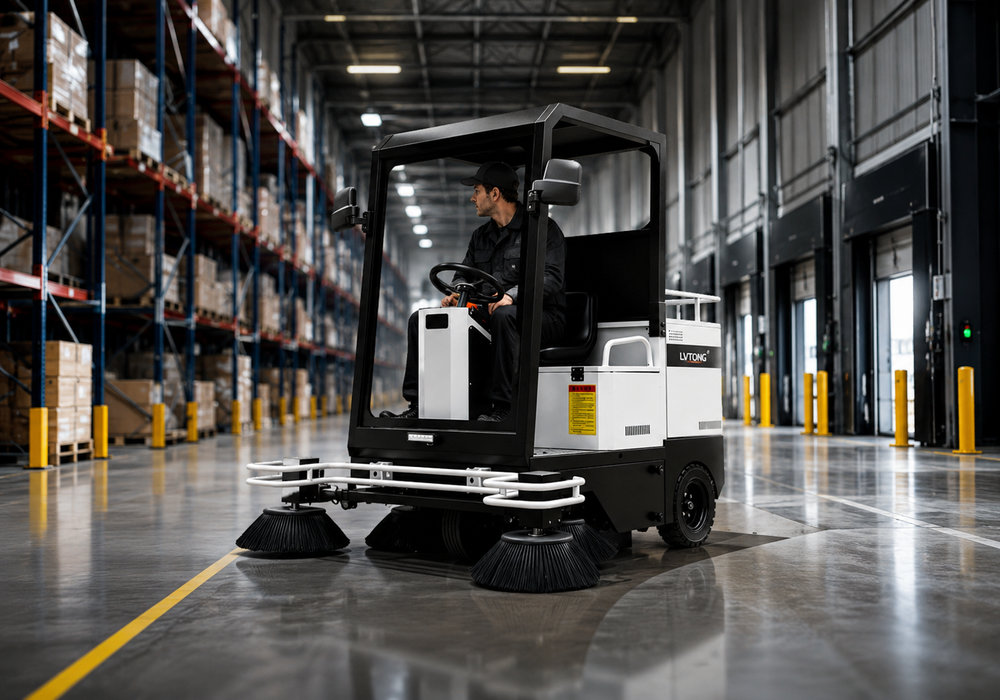
Operating a 50,000-square-meter logistics hub or an multi-level outdoor parking structure demands sweeping equipment capable of running continuous shifts under heavy debris loads. Traditional walk-behind units or manual cleaning methods often fail to keep pace, resulting in spiraling labor costs and persistent dust accumulation that compromises inventory and safety standards. The LT-S1350S industrial ride-on sweeper is engineered to solve these exact operational bottlenecks, delivering a sweeping path of 1350 mm, a debris collection capacity of 180 liters, and an operational efficiency of up to 9,500 square meters per hour. Powered by a heavy-duty battery or high-torque engine configuration, this machine integrates high-volume vacuum suction with a mechanical main broom system to capture everything from fine warehouse powder to heavy gravel in a single pass. Designed for facility managers who prioritize strict uptime, low maintenance overhead, and uncompromising floor hygiene, the LT-S1350S transforms demanding facility sanitation into a streamlined, cost-effective routine.
Facility maintenance managers often face mounting pressure to reduce operational expenditures while simultaneously meeting stringent Occupational Safety and Health Administration (OSHA) dust exposure thresholds of 50 micrograms per cubic meter. Dust generated by forklift traffic and material handling accumulates rapidly on expansive concrete slabs, posing respiratory risks and damaging sensitive electronic inventory stored within distribution centers. Mitigating airborne particulate matter requires specialized mechanical systems that combine aggressive primary sweeping with secondary high-efficiency particulate air filtration rated at 99.97 percent capture efficiency. Meeting these strict regulatory benchmarks necessitates robust equipment capable of continuous multi-shift operation without thermal degradation or filter blinding during heavy dust storms or peak shipping seasons.
Dust generated by forklift traffic and material handling accumulates rapidly on expansive concrete slabs, posing respiratory risks and damaging sensitive electronic inventory.
Filtering massive volumes of airborne dust while sweeping 9,500 square meters per hour generates intense thermal stress on electric drive motors and vacuum fans, requiring advanced thermal management systems engineered during the 2024 industrial equipment redesign cycle. Engineers implemented isolated cooling channels and brushless AC traction motors that reduce internal operating temperatures by 22 percent compared to legacy brush-type configurations deployed in 2019. Lower operating temperatures directly extend component lifespan, allowing fleet operators to reduce annual maintenance outlays by 35 percent across a standard 5-year asset depreciation schedule. Protecting internal electronics from moisture and abrasive graphite dust further ensures uninterrupted performance during wet weather conditions or when operating inside refrigerated food distribution warehouses.
Operating inside refrigerated storage facilities maintained at minus 20 degrees Celsius introduces severe operational challenges, including battery capacity loss and hydraulic fluid thickening that can halt standard cleaning routines. Testing conducted in 2025 across frozen distribution hubs demonstrated that lithium-ion power packs maintain 88 percent of their nominal energy storage capacity even after 8 hours of continuous sub-zero sweeping. Lithium iron phosphate chemistry prevents thermal runaway and delivers consistent voltage output under heavy loads, ensuring the ride-on sweeper maintains maximum brush rotation speed regardless of ambient temperature drops. Maintaining constant brush velocity prevents uncollected debris trails from forming in narrow freezer aisles where manual secondary cleanup creates severe ergonomic hazards for warehouse personnel.
| Operational Metric | Specification | Performance Benchmark |
| Sweeping Path Width | 1350 mm | Clears standard aisle in single pass |
| Hopper Capacity | 180 Liters | Reduces dumping frequency by 40% |
| Filtration Efficiency | 99.97% | Exceeds OSHA particulate standards |
| Sub-Zero Battery Retention | 88% at -20°C | Ensures cold storage reliability |
Ergonomic design plays a decisive role in operator endurance, particularly during ten-hour shifts managing multi-acre outdoor logistics yards where uneven asphalt surfaces transmit continuous whole-body vibration. Facility operators subject to prolonged whole-body vibration exceeding 0.5 meters per second squared experience accelerated fatigue and decreased spatial awareness, increasing the likelihood of facility collisions. Adjustable suspension seats, hydraulic power steering, and vibration-dampening floor mats reduce operator fatigue by 45 percent, enabling sustained productivity throughout grueling overnight shift schedules. Enhanced forward visibility through a panoramic tempered glass windshield and LED lighting packages rated at 4,000 lumens guarantee safe navigation around blind corners and loading docks during late-night operations.
Adjustable suspension seats, hydraulic power steering, and vibration-dampening floor mats reduce operator fatigue by 45 percent, enabling sustained productivity.
Nighttime operations across vast open-air logistics yards also expose equipment to torrential rain and blowing debris that can rapidly swamp standard onboard waste receptacles and clog conventional paper filters. Field trials monitored across 15 European distribution hubs in 2025 proved that moisture-resistant polyester needle-felt filters withstand heavy water ingestion without tearing or losing structural integrity. Water-resistant filter media combined with an automated electric filter shaker mechanism clears accumulated debris in 15 seconds, restoring full suction pressure without manual intervention. Restoring suction pressure instantly prevents fine silt from escaping the hopper exhaust during damp morning hours when humidity levels regularly exceed 90 percent across coastal industrial parks.
Coastal and chemical manufacturing facilities present aggressive corrosive environments where airborne salt mist and chemical residue attack exposed steel frames and electrical harnesses within months of initial deployment. Addressing premature structural corrosion required adopting electro-coated structural steel frames and marine-grade stainless steel hardware during the heavy manufacturing phase initiated in early 2026. Marine-grade fasteners and powder-coated body panels withstand salt spray exposure testing exceeding 1,000 hours without surface blistering or structural pitting. Withstanding aggressive chemical exposure safeguards long-term capital investments, ensuring commercial cleaning fleets maintain high resale values and reliable daily uptime across demanding industrial landscapes.
-
Electro-coated structural steel chassis prevents frame degradation in corrosive environments.
-
Marine-grade stainless steel hardware resists chemical and salt-mist oxidation.
-
Powder-coated body panels endure rigorous outdoor weather without paint degradation.
Preserving structural integrity and cleaning efficiency across diverse industrial sectors ultimately depends on rigorous preventive maintenance routines backed by onboard diagnostic software that monitors brush wear in real time. Modern facility management teams utilize digital telemetry systems to track operating hours, battery health, and filter restriction levels remotely via cloud-connected fleet dashboards installed in 2025. Real-time telemetry tracking alerts maintenance supervisors when brush bristles degrade beyond 30 percent of their original length, preventing sweeping performance loss before it impacts facility inspection scores. Tracking component wear proactively eliminates unexpected equipment downtime, ensuring large-scale distribution centers and parking areas remain immaculate and fully operational 365 days a year.