Buying Rack Space: How Hosting Firms Affect Take-Home Coin
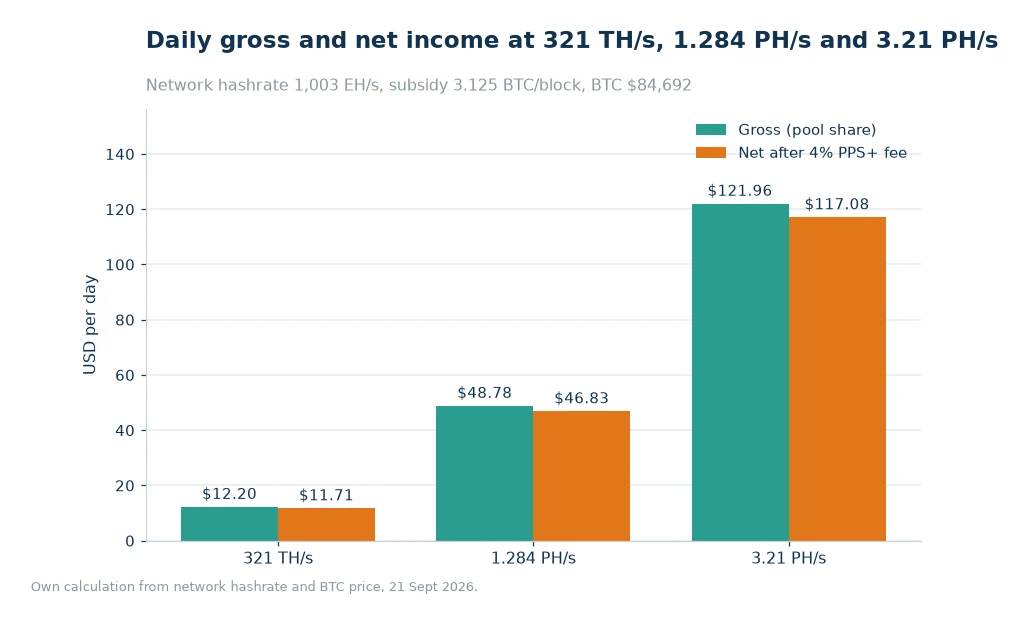
A hosted machine earns exactly what a home machine earns: at 321 TH/s that is 0.000144 BTC a day, $12.20 gross and $11.71 after the listed 4% on the block-reward component. Hosting changes the cost column, the uptime column, and who holds the screwdriver — never the coin column. Buy the slot with that separation firmly in mind.

Key takeaways
- 321 TH/s books 0.000144 BTC daily, $12.20 gross and $11.71 net at $84,692.
- At 3.21 PH/s the same math gives 0.00144003 BTC a day, $121.96 gross, $117.08 net.
- Mining Companies and Miner Hosting directories list vendors; Mining Farms lists facility slots.
- Uptime guarantees move take-home coin more than any quoted power rate ever will.
Separate the two ledgers on day one
Every hosted operation keeps two books. The mining ledger is physics and arithmetic: hashrate divided by network total times 450 BTC a day, minus the listed rate. At 1.284 PH/s that ledger reads $48.78 gross and $46.83 net daily, wherever the hardware sleeps. The hosting ledger is a commercial contract: dollars per kilowatt-hour, per machine per month, plus repair terms.
Trouble starts when buyers let the second ledger masquerade as the first. A quote of "$65 per kW per month all-in" sounds like a yield until you hold it against the mining ledger's $12.20 a day for a single 321 TH/s unit drawing about 3.5 kW. Do the subtraction in dollars per day, per machine, before signing anything — the contract's attractiveness lives entirely in that remainder.
What a directory listing can and cannot promise
Directories exist to shorten the search, not to finish it. The ViaBTC Mining Companies pages gather Mining Companies and Miner Hosting vendors in one place, which beats trawling forums for names. Treat every listing as a lead: real power rate, real uptime clause, real exit terms, all in writing, before any hardware ships.
Three questions filter most vendors in one call. What is the all-in rate per kWh including cooling and fees. What uptime is contractually compensated, not merely targeted. What happens to broken hardware — who diagnoses, who pays parts, how long a unit may sit dark. A vendor fluent on all three has done this before; hesitation on any of them is information too.
Scale the coin math to the fleet you plan
The chart's three bands map to three buyer profiles. One unit at 321 TH/s nets $11.71 a day. A four-unit shelf at 1.284 PH/s nets $46.83. A ten-unit row at 3.21 PH/s nets $117.08 on 0.00144003 BTC. Monthly, those net to roughly $351, $1,405, and $3,512 at a flat BTC price — the figures against which every hosting quote must be measured.
| Fleet size | Net per day | Net per 30 days | Gross per 30 days |
|---|---|---|---|
| 321 TH/s, 1 unit | $11.71 | $351.30 | $366.00 |
| 1.284 PH/s, 4 units | $46.83 | $1,404.90 | $1,463.40 |
| 3.21 PH/s, 10 units | $117.08 | $3,512.40 | $3,658.80 |
Read the table right to left when negotiating. Start from gross, subtract the pool's listed share, then subtract the host's monthly fee and power to find the true remainder. A 10-unit row grossing $3,658.80 that pays $2,000 in hosting and power keeps $1,658.80 before hardware depreciation — comfortable, but only visible when all three subtractions happen on paper first.
Uptime clauses are worth more than cheap power
A $0.01 per kWh discount on 35 kW saves about $8.40 a day. A single day of downtime on a 3.21 PH/s row costs $117.08 of net. The arithmetic is not close: reliability clauses outweigh power discounts by an order of magnitude, yet buyers spend ten times longer haggling the rate than the remedy.
Demand specifics. What percentage uptime is credited, and is the credit automatic or claimed. Whether scheduled maintenance counts against the guarantee. How quickly a failed unit is replaced, and whether replacement capacity or a fee pause covers the gap. Vague promises of high availability cost the vendor nothing; dated, credited commitments cost them exactly what downtime costs you.
Repairs, firmware, and the hands problem
Someone must clean filters, reseat cables, and flash firmware, and in a hosted deal that someone is not you. Clarify the boundary: routine hands included, board-level repair billed how, parts sourced by whom, and who decides when a unit is retired rather than repaired. A dead hash board on a $46.83-a-day shelf bleeds $1.40 an hour, so response-time language is money language.
Also settle firmware authority. Pool-side efficiency updates and security patches arrive regularly, and a host that batches them across hundreds of units may delay yours by weeks. Agree who approves updates and how quickly they roll out, because a month on stale firmware is a month of avoidable stale shares. The Mining Farms listings describe facility-side services; use them to benchmark what competent hands should include.
Model the exit before you model the entry
Every hosting relationship ends — in upgrade, relocation, or dispute — so price the exit now. Minimum terms, notice periods, removal fees, and who pays freight on ten units of dead weight all belong in the first spreadsheet, not the last argument. A contract that is cheap to enter and expensive to leave is not cheap.
Run the depreciation alongside. Ten units earning $117.08 net a day look different in month one, when hardware is new, versus month thirty, when difficulty has risen and resale has fallen. If the hosting term outlasts the hardware's economic life, the miner carries ageing yield against fixed fees — the classic squeeze. Match term length to realistic hardware horizons, and keep the Profit Calculator open while you do, testing each year of the term at higher difficulty.
Insurance, access, and the clauses buyers skip
Two clauses separate professional hosts from risky ones, and neither concerns price. First, insurance: whose policy covers your hardware inside their building, against fire, flood, and theft, and what documentation proves it. A host operating without equipment coverage is asking you to self-insure silently; price that exposure into the quote or walk away. Second, access: can you inspect your machines with reasonable notice, and can an independent technician enter on your behalf. Facilities that forbid all visits fail this test permanently.
Payment structure deserves equal scrutiny. Monthly billing costs slightly more per unit but preserves the exit option that keeps vendors honest; annual prepayment at a discount converts you into an unsecured creditor of the host for the discount amount. New relationships should start monthly for at least one quarter regardless of the discount on offer. Move to longer terms only after the vendor has survived a failure event — a real outage handled well tells you more than any sales call about what the next two years will feel like.
Worked example
Verify the single-unit band from network constants upward.
- Network: 1,003,000,000 TH/s total, 450 BTC issued daily.
- Share of 321 TH/s: 321 ÷ 1,003,000,000 = 0.00000032.
- Daily BTC: 0.00000032 × 450 = 0.000144 BTC.
- Gross: 0.000144 × 84,692 = $12.20.
- Net after the listed 4%: $12.20 × 0.96 = $11.71.
- Ten times the hardware, 3.21 PH/s: 0.00144003 BTC, $121.96 gross, $117.08 net.
- Middle band, 1.284 PH/s (four times 321 TH/s): $48.78 gross, $46.83 net.
Frequently asked questions
Does hosting change my pool earnings?
No. At 321 TH/s the pool credits 0.000144 BTC a day wherever the unit sits; hosting alters costs and uptime, never the settlement math.
Which matters more, power rate or uptime?
Uptime, by far: one dark day on a 10-unit row costs $117.08 net, dwarfing typical per-kWh savings of a few dollars.
How long a term should I sign?
Match it to the hardware's realistic earning life; a term that outlives profitability turns fixed hosting fees into a monthly loss.
Sign the contract that survives bad months
Model the deal at today's difficulty, then at 20% higher difficulty with 10% lower BTC, and sign only if the remainder still pays the power. The coin math — $11.71 net per unit per day at current reads — is the fixed star; every clause in the hosting contract is just weather around it. Choose the vendor whose terms look fair in the storm, not only in the sunshine.
Sources: pool company and farm listings plus the listed-fee schedule for the 4% figure[1]. Chain data read 21 Sept 2026: network hashrate 1,003 EH/s, difficulty 132.76 T, 3.125 BTC per block, 144 blocks a day, BTC $84,692. Published 24 Oct 2026; figures are arithmetic on those inputs.